

Challenge Test or TVC? What Cosmetic Brands Need to Know About Microbiological Testing
Two tests. Two different questions. Many brands confuse them — or commission only one when both are needed. Here is how to tell them apart and use each correctly.
When brands come to us at Elinek for microbiological testing, one of the first things we clarify is the distinction between the Preservative Efficacy Test (commonly called the challenge test) and the Total Viable Count (TVC) — also known as the microbial limit test. These two tests answer fundamentally different questions, and understanding the difference will save you time, money, and compliance headaches.
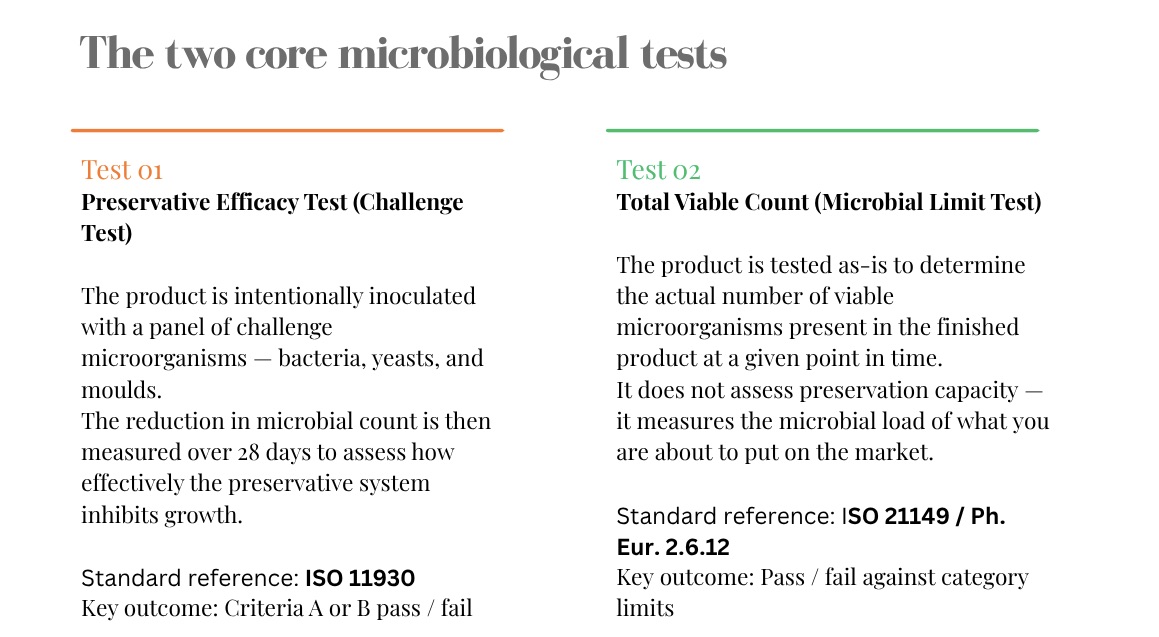 In simple terms: the challenge test tells you whether your preservative system can defend the product against contamination. The TVC tells you whether the product is already contaminated — or within acceptable microbial limits — at the time of testing.
What the challenge test actually involves
ISO 11930:2019 defines the standard methodology for preservative efficacy testing of cosmetics. The test uses five reference microorganisms: Pseudomonas aeruginosa, Staphylococcus aureus, Candida albicans, Aspergillus brasiliensis, and Escherichia coli. Each is introduced into the product at a defined concentration, and viable counts are taken at days 7, 14, and 28.
Results are evaluated against two sets of criteria:

Important: Products intended for use around the eyes, on broken or damaged skin, on children under three years of age, or on immunocompromised individuals require particular attention.For these categories, Criteria A is strongly preferred, and any deviation requires robust scientific justification.
When is each test required?
- Challenge test: required for every new formula and for any reformulation that changes the preservative system, water activity, or pH.
- TVC: required as part of finished product release testing and stability studies. It confirms the product meets the microbial limits defined in ISO 17516 for its category.
- Both together: needed at product launch and recommended whenever a significant change is made to the formula, manufacturing process, or packaging.
- Repeat testing: recommended at defined stability timepoints (e.g., 3, 6, 12, 24 months) to confirm microbiological quality is maintained throughout shelf life.
The microbial limits that apply to your product
ISO 17516:2014 sets the microbiological limits for cosmetic products, divided into two categories:
| Parameter | Category 1 | Category 2 |
|---|---|---|
| Total aerobic microbial count (TAMC) | ≤ 100 CFU/g or mL | ≤ 1,000 CFU/g or mL |
| Total yeast & mould count (TYMC) | ≤ 10 CFU/g or mL | ≤ 100 CFU/g or mL |
| Staphylococcus aureus | Absent in 1 g or 1 mL | |
| Pseudomonas aeruginosa | Absent in 1 g or 1 mL | |
| Candida albicans | Absent in 1 g or 1 mL | |
Category 1 applies to products for use around the eyes, on mucous membranes, and on children under three. Category 2 covers all other cosmetic products.
What happens when a test fails
A challenge test failure does not automatically mean the product cannot be marketed — but it does mean the formula needs to be reassessed. The most common responses are adjusting the type or concentration of preservatives, modifying the pH, reducing the water activity, or changing the packaging to reduce contamination risk during use.
A note on “preservative-free” formulas: products marketed as free from traditional preservatives are not exempt from challenge testing. They still need to demonstrate adequate microbial protection — whether through alternative preservation strategies (low pH, high alcohol content, anhydrous systems) or by meeting Criteria B with a justified risk assessment. The regulatory obligation does not change based on marketing claims.
A TVC failure at any stage — whether during stability testing or on a finished batch — requires a root cause investigation before product release. At Elinek, our microbiology laboratory is equipped to support both the initial testing and any follow-up investigation, with direct communication between the lab and the regulatory team.
The documentation your Safety Assessor needs
- Full challenge test report (ISO 11930) with raw data, criteria evaluation, and pass/fail conclusion
- TVC results for finished product (release and stability timepoints)
- Specification limits defined for your product category
- Any out-of-specification results and associated investigations
- Water activity data, if used as part of the preservation strategy
- Packaging details relevant to microbial risk (airless, wide-mouth, multi-use, etc.)
Need microbiological testing for your product?
Elinek’s in-house microbiology laboratory performs Challenge Test (ISO 11930) and TVC / Microbial Limits (ISO 17516) across all cosmetic categories, with full regulatory support for CPSR and compliance.
EOF-Licensed · ISO 9001 Certified