
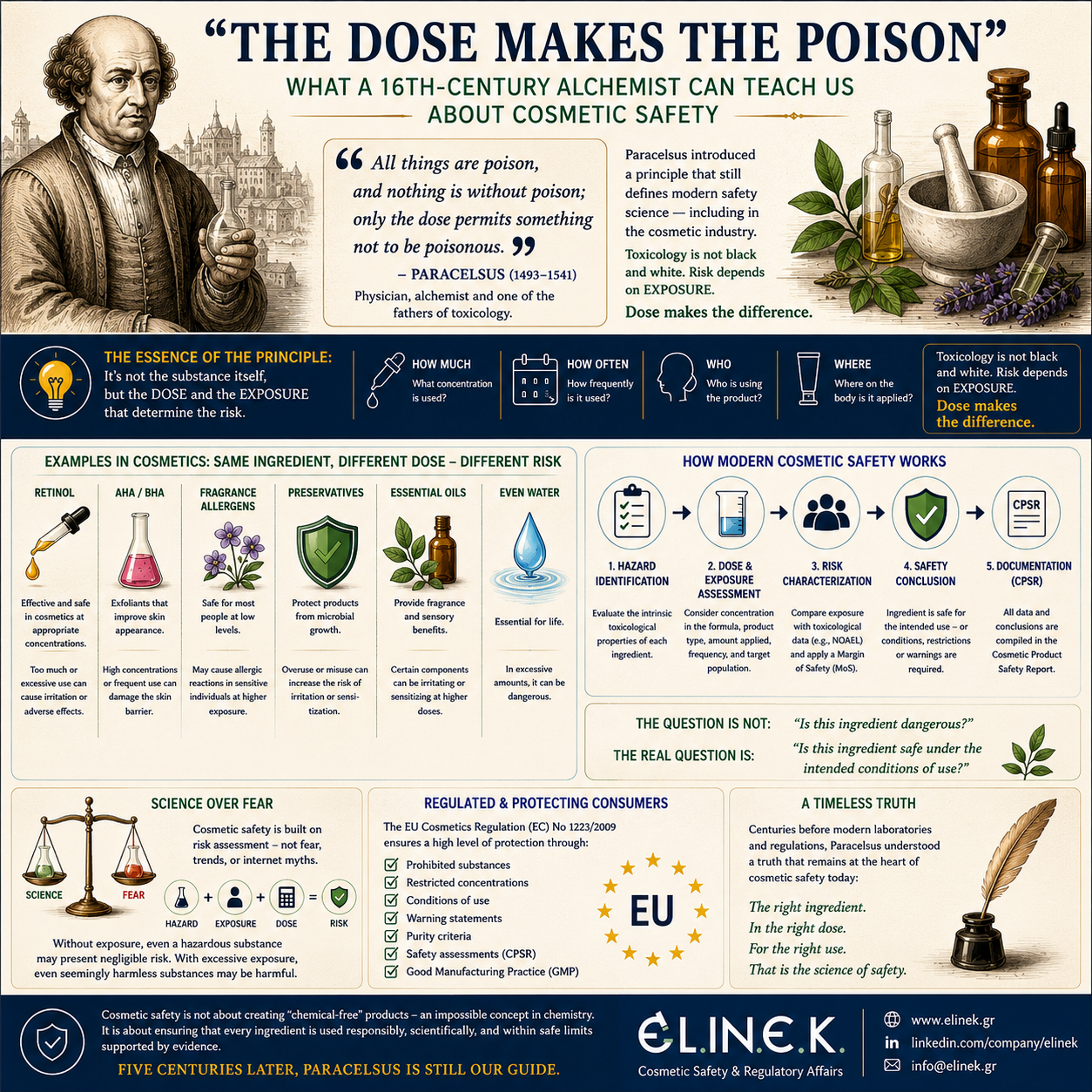
“The Dose Makes the Poison“
What a 16th-Century Alchemist Can Teach Us About Cosmetic Safety
“Sola dosis facit venenum.”The dose alone makes the poison. — Paracelsus, ~1538
This phrase is over 500 years old — and it still sits at the heart of modern toxicology. It was written by Paracelsus, a Swiss-German physician and alchemist, sometime in the early 1500s.
He was talking about poisons and medicines. He could just as well have been talking about your moisturiser.
Everything is toxic. Everything is safe. It depends.
Water can kill you. Oxygen, at high enough concentrations, is toxic to the lungs. Vitamin A — essential for skin health and cell renewal — causes severe birth defects at excessive doses. Salicylic acid, a staple of acne treatments, is a close relative of aspirin and can be absorbed through the skin.
None of this means these ingredients are dangerous in your cosmetic products. It means the question “is this ingredient safe?” is, on its own, incomplete.
The right question is: safe at what level, applied how, by whom, for how long?
How cosmetic safety assessors actually think
When evaluating a product, a safety assessor is not asking “is retinol dangerous?” They are looking at the full picture:
- What is the concentration in the formula?
- Is the product rinsed off immediately, or left on skin all day?
- Where is it applied — lips, scalp, full body?
- How often is it used?
- Who is using it — an adult, a child, a pregnant woman?
The same ingredient at the same concentration can have a completely different safety profile depending on how, where, and how often it is used. This is not a technicality. It is the core logic of cosmetic safety evaluation.
A practical example: Vitamin A
The EU recently restricted Vitamin A (retinol and retinyl esters) in cosmetic products — Regulation (EU) 2024/996 — precisely because of dose-dependent concern. Vitamin A is not banned. It is calibrated: maximum concentrations are defined, and a mandatory label warning is required.
Paracelsus, distilled into EU regulation.
Why this matters for cosmetic brands
The safety of your product is not a property of your ingredient list alone. It is a property of your formulation as a whole, evaluated in its specific use context.
This is why cosmetic safety assessment is not a checkbox. It is a scientific evaluation — product by product, use by use.
Paracelsus lost most of his battles. But this one idea became the foundation of toxicology as we know it. Every time a cosmetic safety assessor evaluates a product, they are doing exactly what he described.