
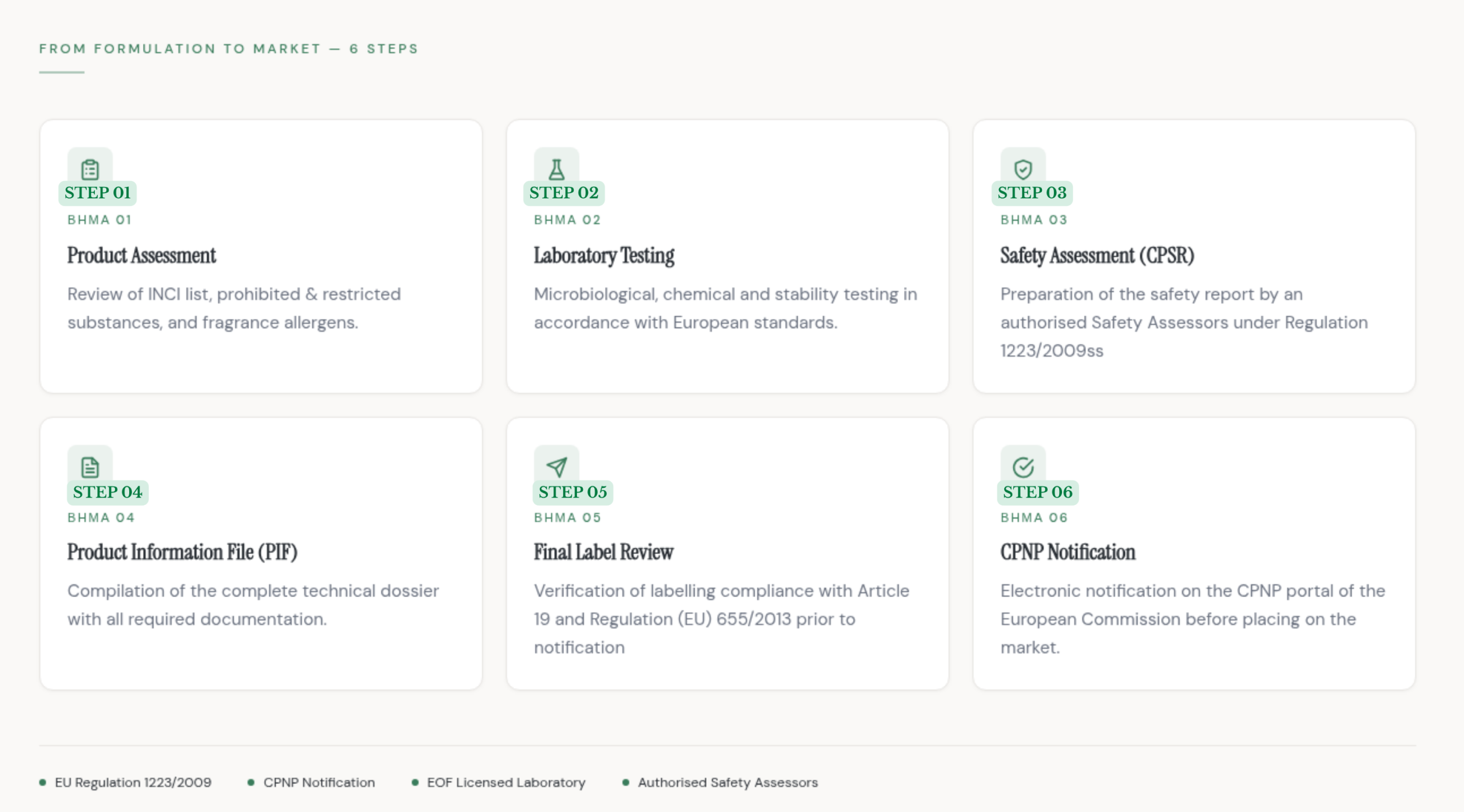
Entering the European market requires full compliance with Regulation 1223/2009. ELINEK undertakes every step of the process — from the evaluation of the composition to the notification to the CPNP.
Placing your cosmetics to Europe
Placing cosmetics on the European market ELINEK undertakes every step of the process — from the evaluation of the composition to the notification to the CPNP.
Laboratory licensed by the Hellenic National Organisation of Medicines, with specialized Safety Assessors since 1997.
Product Information File (PIF)
Regulation (EC) No 1223/2009, known as Cosmetics Regulation, entered into force on 11 July 2013 and requires Responsible Persons to compile the Product Information File (PIF) for each product available on the market.
PIF, according to Article 11 of the Regulation, aims to collect all relevant information concerning the cosmetic product. Must be kept by the Responsible Person for ten years from the last batch of cosmetic product produced and placed on the market.
Product Information File (PIF) contains the following:
- Producer’s GMP
- Formulation of the cosmetic product
- Raw material specifications (MSDS, TDS, Certificate of analysis, IFRA Certificate, Allergens Certificate)
- Product information (physicochemical characteristics, production method, packaging materials)
- Laboratory tests (Challenge test, stability test, dermatological test, effectiveness studies such as SPF, UVA,).)
- Safety Assessment
- Toxicological profile of the product
- Label (outer and inner packaging)
Our specialists can assist you in compiling the PIF.
Cosmetic Product Safety Report (CPSR)
According to Regulation 1223/2009, cosmetic productσ must have a Safety Assessment Report by a specialized Safety Assessor before placing them on the European market. The Safety Assessment Report is an important and mandatory part of the Product Information Folder (PIF)
The Safety Report always includes two parts:
- Part A: Safety Information
- Part B: Safety Assessment
PART A- Cosmetic product safety information
- Quantitative and qualitative composition of the cosmetic product
- Physical/chemical characteristics and stability of the cosmetic product
- Microbiological quality
- Impurities, traces, information about the packaging material
- Normal and reasonably foreseeable use
- Exposure to the cosmetic product
- Exposure to the substances
- Toxicological profile of the substances
- Undesirable effects and serious undesirable effects
- Other information on the cosmetic product
PART B-Cosmetic product safety assessment
- Assessment conclusion
- Labelled warnings and instructions of use
- Reasoning
- Assessor’s credentials and approval
ELINEK has the ability to conduct the Cosmetic Product Safety Report of your products and comply with the requirements of the Regulation 1223/2009.
Cosmetic Products Notification Portal (CPNP)
Before placing a cosmetic product on the European market, it is responsibility of the Responsible Person to notify the product at the European portal, and obtains a unique notification number.
However, distributors who import a product from one European country to another European country, translating only the label into their native language should notify it as a distributor product.
ELINEK can undertake the process starting from the creation of your company’s account on the European platform until the notification of your product.
Label Review & Claims
According to Regulation 1223/2009, the labeling (inner and outer packaging) must contain the following information:
- The name and address of the Responsible Person
- Country of origin if the product is imported from outside the EU
- Nominal content of the product, given by weight or volume
- Date of minimum durability or Period After Opening
- Precautions to be observed in use
- Production batch number
- Function of the product, unless it is clear from its presentation
- List of ingredients (can only be found on the outer packaging)
Claims made on cosmetic products should not mislead consumers or imply that the cosmetic product has a feature or function that it does not. Regulation 655/2013 and relevant directives were developed to provide further clarity on the criteria that claims must meet in order to be considered admissible under Regulation (EC) No. 1223/2009. These requirements apply not only to on-label labeling, but to all promotional materials, such as advertisements, flyers, and websites.
ELINEK can assist you in order the labeling of your products to be in accordance with the Cosmetics Legislation.
Toxicological Profile of Raw Materials
The Product Information Package (PIF) also includes the toxicological profile of the substances contained in the cosmetic product. The review of the toxicological profile of each material is based on literature. Special emphasis is given to the evaluation of local toxicity (eye and skin irritation), skin sensitization, absorption of ultraviolet radiation, etc.
ELINEK has the ability to evaluate the toxicological profile of any substance that may be contained in a cosmetic product.
Stability Test
The purpose of Stability Testing cosmetic products is to ensure that a new or modified product meets the intended physical, chemical and microbiological quality standards as well as functionality and aesthetics when stored under appropriate conditions. The during of the Stability test is 3 months. Tests are performed in ambient conditions, at light, at 40C, 370C, 450C and in 5 cycles (low – high temperatures). The parameters that are examined at regular intervals are the following:
- Microbiological tests
- Physicochemical test (color, odor, pH value, viscosity, texture, specific gravity, and emulsion stability (signs of separation).)
- Packaging Tests (weight loss tests, ) leaking tests
ELINEK has the ability to customize the duration of the test, control intervals, temperatures and parameter tests that can be applied, depending on your requirements.
REFERENCES:
- Guidelines on Stability testing of cosmetic products, CTFA and COLIPA, 2004
- ISO/TR 18811: Cosmetics — Guidelines on the stability testing of cosmetic products
Preservative Efficacy Testing (Challenge Test)
The ability of microorganisms to grow in inadequately preserved cosmetics creates visible defects, but also endangers the health of consumers of possible bacterial contamination.
With the Challenge test is determined the ability of the preservation of the cosmetic, as the product is inoculated with a controlled inoculum of the challenge organism(s) and then the number of survivors is determined at different time points.
ELINEK can conduct challenge test according to a range of standards such as:
- ISO 11930:2019- Cosmetics — Microbiology — Evaluation of the antimicrobial protection of a cosmetic product
- USP 51 Antimicrobial Preservative Efficacy
- European Pharmacopeia -E.P. 5.1.3
- Toiletry and Fragrance Association (CTFA) Microbiology Guidelines
Microbiology Testing for Cosmetics
Α. MICROBIOLOGICAL TESTING FOR COSMETICS
ELINEK carries out the necessary microbiological tests that must be performed on each batch of cosmetic products that are placed on the market and / or exported, as well as on raw materials used.
The tests which are performed are: The total aerobic microbial count, as well as the detection and identification (biochemical tests) of the following pathogenic microorganisms: Ps.aeruginosa, St.aureus & Candida albicans based on methods of the European Pharmacopoeia and ISO.
Β. MICROBIOLOGICAL TESTING FOR COSMETICS
ELINEK carries out all the required tests in the production water. The total number of bacteria (220C & 360C), total coliforms, E.coli, Intestinal Enterococci, Pseudomonas aeruginosa and Clostridium perfringens are performed based on ISO methods.
Chemical Testing
Α. ΦΥΣΙΚΟΧΗΜΙΚΟΣ ΕΛΕΓΧΟΣ ΝΕΡΟΥ
Our modern chemical laboratory is able to provide the necessary physicochemical analyzes in water which include the following parameters:
pH, Conductivity, Soluble Solids, Total Hardness, Oxidizable Substances, Aluminum (Al), Ammonium (NH4-N) Calcium (CaCO3), Magnesium (Mg), Chloride (Cl), Heavy Metals (Pb), Nitrate (NO3 –N), Sulfate (SO4).
Β. DETERMINATION & INDENTIFICATION OF RAW MATERIALS
Chemical analyses are important source of information for both raw material and final product producers. Some of the performed analyses we conduct are:
- Quantitative determination of raw materials
- Quantitative determination of raw materials in a final product
- Qualitative determination of raw materials
- Acidity of raw materials or final product
For further information about the chemical analysis, you can contact our experts.
Γ. DETERMINATION OF SUBSTANCES & IMPURITIES
Impurities are generally minor constituents of a substance or a raw material that can originate from:
-
Constituents themselves
-
The manufacturing process
-
Chemical synthesis or interaction within the product that could occur under normal storage conditions
-
Potential migration from the final packaging to the product
-
Potential chemical changes caused by instability of the product in contact with the final packaging.
Contaminants are defined as unintended substances that can originate from sources outside the chemical pathway, chemical processes, and unexpected situations such as bad storage of primary substances or instability of the primary packaging.
Some trace substances are prohibited or restricted in different jurisdictions around the world. The final responsibility for ensuring the safety and regulatory compliance of a cosmetic product (including any trace substances it may contain) lies with the entity responsible for placing the product on the market (i.e. manufacturer, distributor and/or importer). Appropriate testing of traces in cosmetic products is thus required.
ELINEK can determine the presence of substances and impurities in the final product. Some of the analyses are the following:
- HEAVY METALS (Arsenic (As), Lead (Pb), Chromium (Cr), Cadmium (Cd), Cobalt (Co), Nickel (Ni)
- FORMALDEHYDE
- DIOXINE
- ALLERGENS IN FINAL PRODUCT (26 fragrance allergens for cosmetic products)
For further information you can contact our experts
Patch Test
It is the evaluation of the irritant effect of cosmetic products when applied in single dose to the intact human skin. The test is run on healthy volunteers of both sexes, which have given a written consent to the experimentation.
Each product is tested on 20 volunteers. Samples are posed into allumin Finn chambers (Bracco), and applied to the skin of the forearm or the back protected by self –sticking tape. The evaluation of skin reactions is made 15 min and 24 hours after removal of the Finn chambers.
After the successful completion of the Patch test you can use the claim “Dermatologically Tested”.
This test can also be applied to sensitive skin where the used claims can be “Dermatologically tested on sensitive skin/ Suitable for sensitive skin” or similar.
Ophthalmological Checking in Vitro
The Irritection® test system is an innovative test that includes the use of purposely designed matrix and of the equipment necessary to read and elaborate the resulting data with a dedicated software that permits the identification and prediction of the ocular irritation potential of the products in the
different forms available.
The claims that can be used are “Ophthalmological tested-In Vitro, No Tears (In-Vitro) or similar.
Efficacy Tests
According to Regulation no. 655/2013, cosmetic products and cosmetics must justify and prove the advertised claims with sufficient and verifiable evidence.
ELINEK can provide the appropriate tests and reports to make your claims a fact by proving their legitimacy, in order to substantiate those all-important claims that appear on your packaging or in your advertisements.
Some of the most important efficacy tests are:
- ANTI-WRINKLE TEST
- Non-COMEDOGENIC
- MOISTURIZING TEST
- SEBO-BALANCING TEST
- ANTI-POLLUTION TEST
- OPHTHALMIC TEST
- BAG & EYE DARK CIRCLE TEST
- ANTI-CELLULITE TEST
- ANTI-STRETCH TEST
- SOOTHING & PROTECTIVE TEST
- TOLERABILITY TEST ON EXTERNAL VAGINAL SKIN & MUCOSA
- LONG-LASTING TEST for make-up products
- WATERPROOF TEST for make-up products
- LIP PLUMBER
- ANTIDANDRUFF TEST
- HEAT PROTECTION for hair
- BABY NAPPY TESTS
ELINEK can offers standard and customized efficacy tests even in personal care products and medical devices.
For additional efficacy tests, please contact our specialists.
SPF, UVA & Water Resistant
A. ΙN-VIVO DETERMINATION OF THE SUN PROTECTION FACTOR (SPF)
This test, carried out on 10 volunteers, allows you the labeling of SPF.
Generally, as a first step, the test is carried out on 5 volunteers, and in case of negative results, it will be possible to stop it at this preliminary level. On the contrary, if results are good the test will be completed on the remaining 5 volunteers.
Claims as “Water Resistant” or “Very water resistant”, the test must be done simultaneously with the determination of the Sun Protection Factor (SPF)
The water resistance is evaluated by measuring the SPF before and after immersion in water (static and wet SPF).
Β. IN VITRO METHOD FOR THE DETERMINATION OF THE UVA PROTECTION FACTOR
This test evaluates if the investigated sunscreen product can absorb in the UV spectrum (UVA+UVB). Scope of this experimental protocol is to measure in vitro the UVA protection of sunscreens.
Free Sale Certificate
What is a Certificate of Free Sale?
EU cosmetic companies exporting to third countries are often asked to provide a Certificate of Free Sale (CFS) as part as their export dossier. This certificate is a declaration attesting that the product intended to be imported is compliant with the EU Cosmetic Products Regulation and may therefore be freely sold across the EU.
Why is a CFS issued in an EU Member State important for international trade?
Many countries outside the EU have a system of pre-market product registration, which requires specific documentation to guarantee that a product is safe and complies with international cosmetic regulations. A CFS is the main document that provides assurance that the product is formulated and manufactured in accordance with the EU Cosmetic Products Regulation.
Since the European Union has a well-structured and efficient regulatory system for cosmetics, a CFS issued in an EU Member State is widely accepted internationally.
CFS’s are usually issued by the national Competent Authority or a relevant organization, which could be a Government Department, a trade association or a Chamber of Commerce.
ELINEK can undertake the issue and the whole process in order to obtain a CFS for your cosmetic products.
Safety Data Sheets (SDS) and Cosmetic Products
Cosmetics are specifically exempt from the requirement to have a MSDS and alternative labeling, and warnings of cosmetic products is permitted in accordance with the safety assessment of the final product and EU Cosmetics Regulation.
Cosmetic ingredients though as raw materials or a bulk of a cosmetic product are not exempt.
However, a SDS is needed when retailers and distributors need to carry and storage your products, in order to know the dangers, composition, safe handling and disposal of the chemicals and substances used in your products.
A SDS is needed also for the transport of a cosmetics product.
There are generally 16 sections to an SDS. It may have words or hazard symbols, and the sections are not limited to:
- Identification of the chemical & supplier contact information
- Hazards identification
- Composition of ingredients
- First aid measures upon exposure
- Firefighting information
- Accidental release measures
- Handling and storage
- Exposure controls and personal protective equipment
- Physical and chemical properties
- Stability and reactivity
- Toxicological information
- Ecological information
- Disposal considerations
- Transport information
- Regulatory information
- Additional information
Certificate of Analysis (COA) of a cosmetic product
What is Certificate of Analysis (COA)?
A Certificate of Analysis, or COA, is a document that establishes that a product was analytically tested and meets specifications of safety and quality. COA is a document that gives actual test results for the batch of cosmetic products that a cosmetic company is exporting.
To obtain a COA, samples may be sent to ELINEK for analysis, where we will perform the standard cosmetic testing panel. Results will be issued in the form of a Certificate of Analysis for each individual product. The standard panel includes the most common tests used to determine product safety and quality for cosmetics.
A COA usually includes:
- Microbial testing to check the absence of microbial counts as well as pathogens
- All kinds of physical testing such as viscosity, pH, specific gravity, etc.
- Presence of heavy metals like lead, arsenic, mercury, in certain type of cosmetics like makeup products.