Sunscreen Labels in the EU: What You Can and Cannot Claim
Sunscreen is the most heavily regulated cosmetic category in Europe. The gap between what brands want to say and what the rules actually permit is wider than most expect — and the consequences of getting it wrong extend well beyond a label revision.
Regulatory framework
Sunscreen products in the EU are governed by three overlapping instruments:
Regulation (EC) No 1223/2009 (the main cosmetics regulation),
Commission Recommendation 2006/647/EC (efficacy, claims, and labelling), and
Regulation (EU) No 655/2013 (common criteria for cosmetic claims).
These instruments operate cumulatively. A label that aligns with one but conflicts with another may still be considered non-compliant.
Unlike most cosmetic categories, sunscreen labelling carries a public health dimension. Inaccurate or misleading sun protection claims can lead consumers to underestimate their UV exposure — with serious consequences. This is precisely why the European Commission issued a dedicated Recommendation for sunscreens, and why national authorities treat non-compliant sunscreen labels with particular seriousness.
What follows is a practical guide to the most common labelling requirements, illustrated throughout with compliant and non-compliant examples drawn from real-world brand practice.
1. The SPF number: what you can actually print
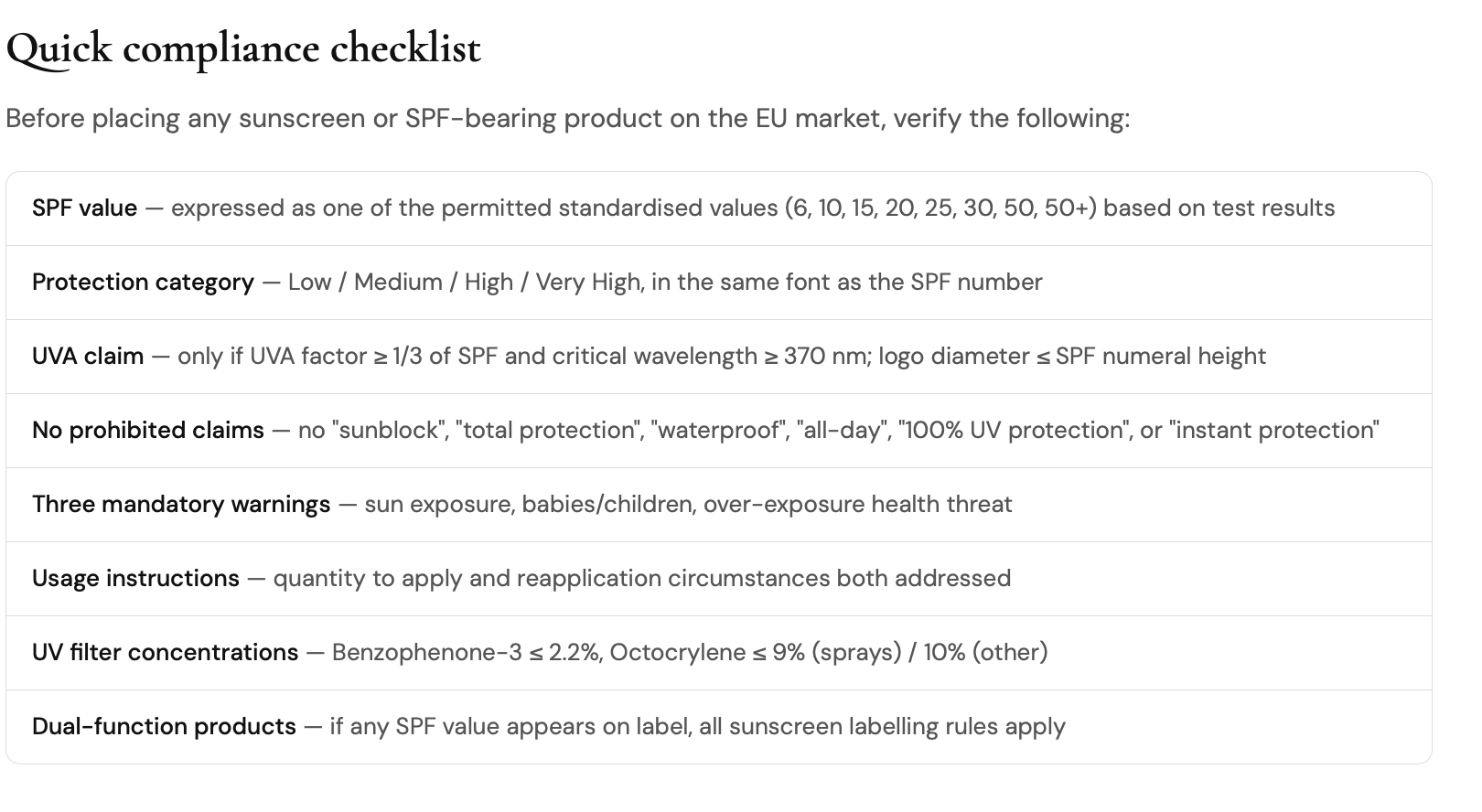
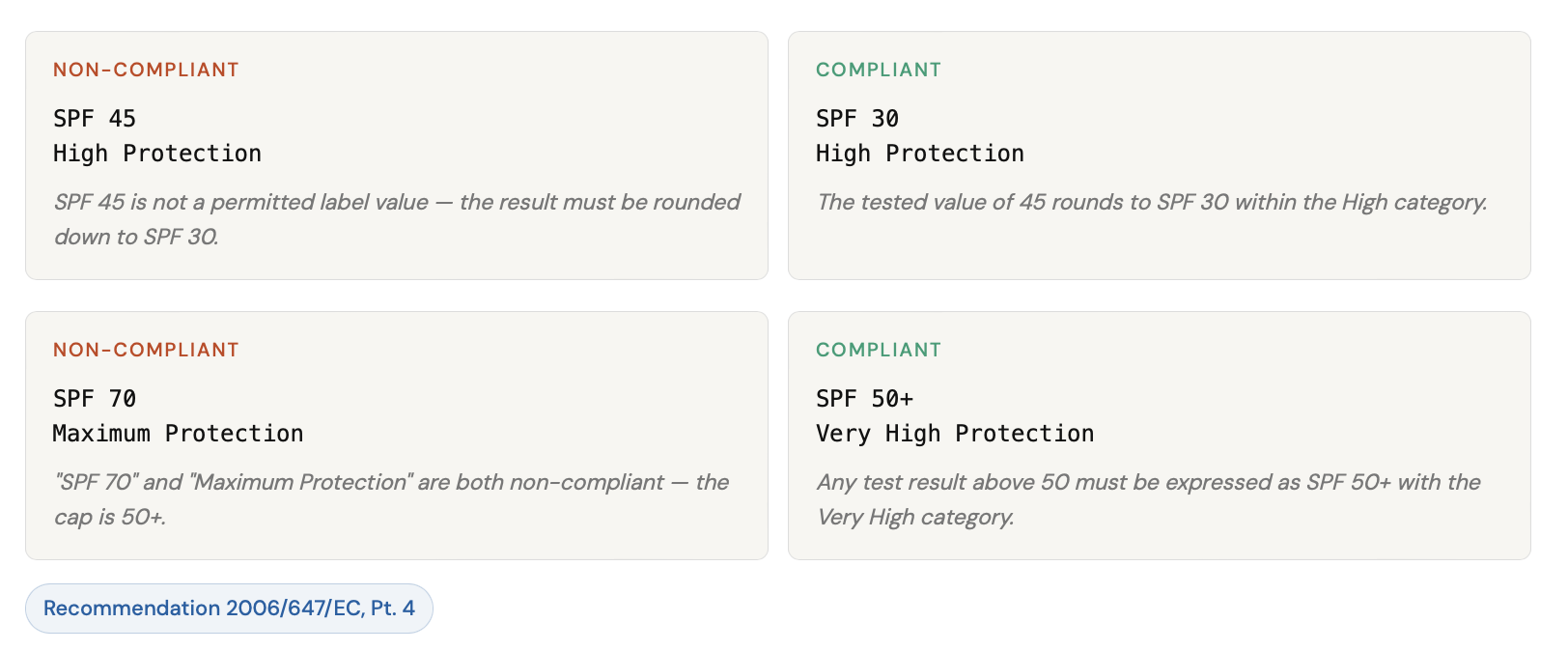
In practice, EU sunscreen labels are expected to indicate efficacy using the standardized SPF values and protection categories set out in the Recommendation. However, the number you print is not simply the number your testing laboratory returns. The Recommendation establishes a standardised rounding system: regardless of the exact test result, the SPF should be expressed as one of eight fixed values — 6, 10, 15, 20, 25, 30, 50, or 50+. Any result above 50 must be labelled as SPF 50+.
Alongside the SPF number, the label must display the product’s protection category at least as prominently as the SPF. There are four categories:

2. UVA protection: the 1/3 rule and the logo
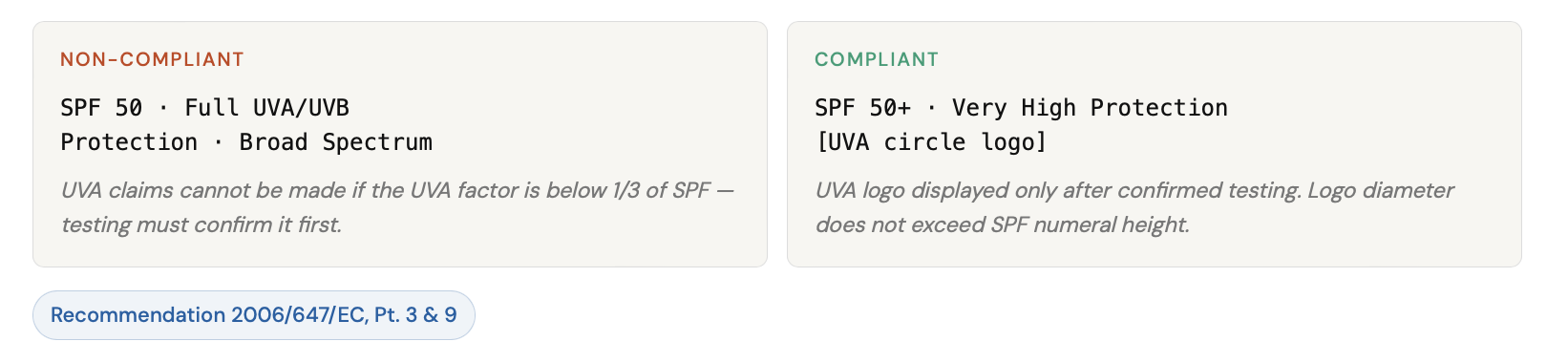
A sunscreen product may only make a UVA protection claim if its UVA protection factor is at least one-third of the labelled SPF value. This is the critical UVA/UVB ratio requirement. A product labelled SPF 30 must therefore demonstrate a UVA protection factor of at least 10. If it does not, it cannot carry any UVA claim.
In addition, the minimum critical wavelength of the product must be at least 370 nm — confirming true broad-spectrum coverage across the UVA range.
When the UVA requirement is met, brands may display the Cosmetics Europe UVA logo: the letters “UVA” inside a circle. If used, the diameter of this logo must not exceed the height of the SPF number on the label.
3. Prohibited claims: the most common mistakes
This is where brands most frequently run into problems. The Recommendation explicitly bans a category of claims that imply total or permanent protection — because no sunscreen product can deliver either. The list below reflects what appears regularly on labels and packaging, and what must be replaced.
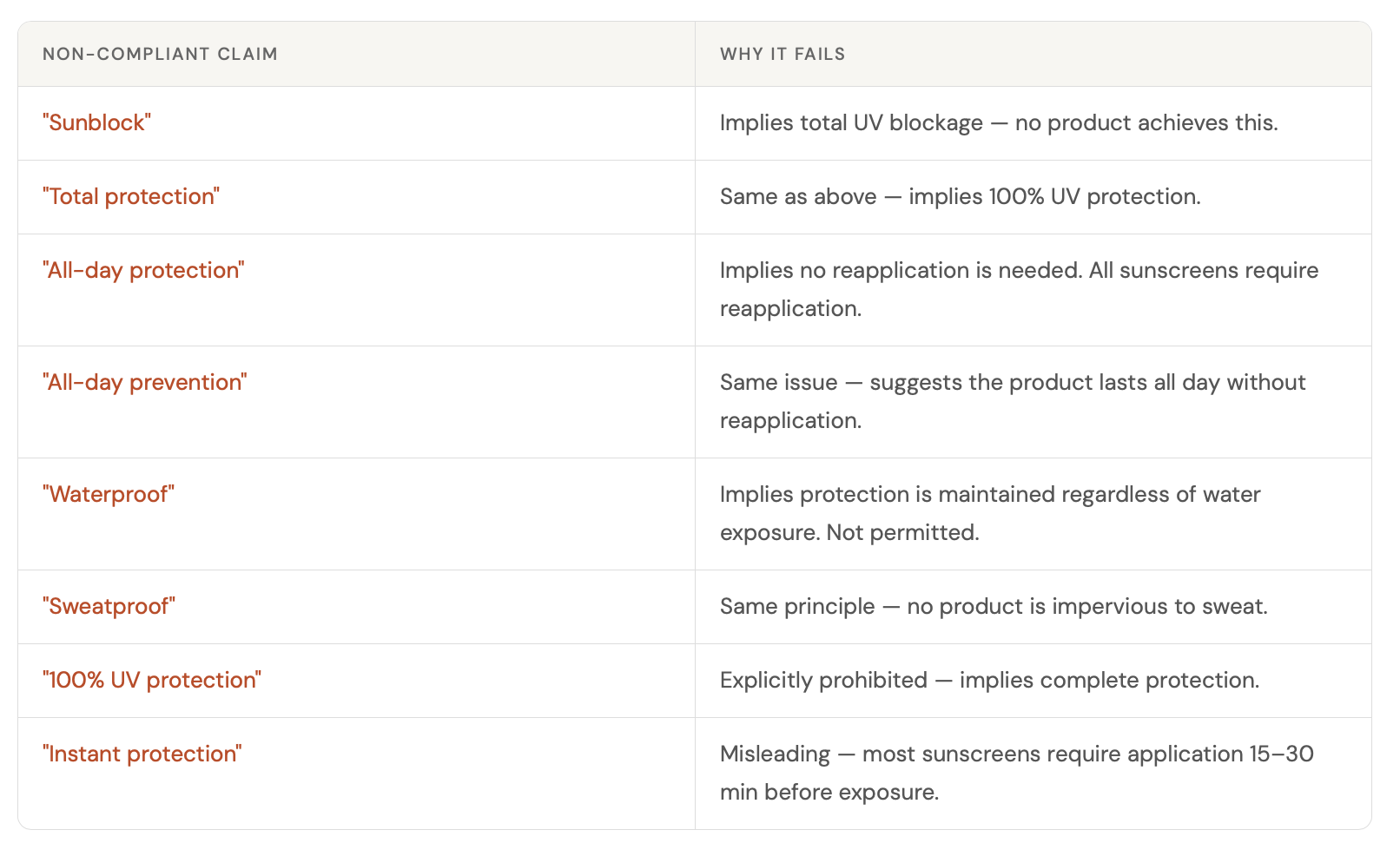
Water-resistance and similar durability claims should be carefully substantiated and assessed under the common-criteria rules for cosmetic claims.
4. Mandatory warnings and usage instructions
Every sunscreen label should display three specific precautionary statements and a set of usage instructions. The Recommendation advises that sunscreen labels should include precautionary statements and usage instructions. In practice, these warnings are widely expected by national authorities and are treated as essential for compliant labelling.
The three precautionary statements are:
In addition, the label should include usage instructions that address two things: how much product to apply (in order to achieve the stated SPF — since testing is conducted at 2mg/cm²), and when to reapply. This can be done through text, a pictogram, or a measurement reference.
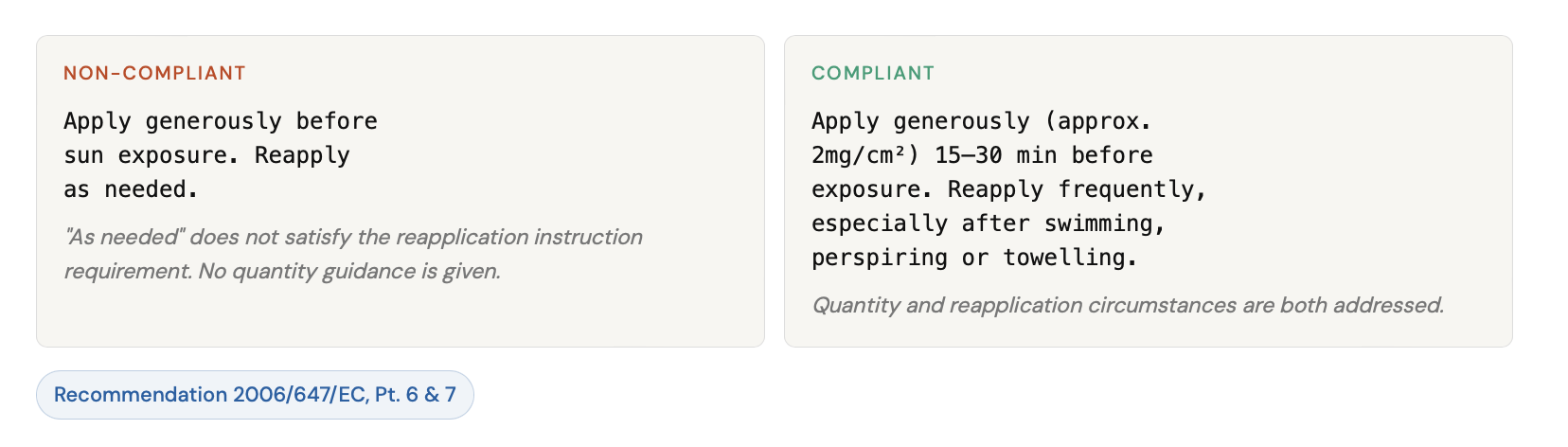
Note on label language: Under Article 19(5) of Regulation 1223/2009, usage instructions and mandatory warnings must appear in the official language of the country where the product is sold. This means that for each market where the product is placed, phrases such as reapplication instructions and the three mandatory precautionary statements must be in the local language.
The protection category (e.g. “High Protection”) is not explicitly defined as a mandatory translation requirement under the Recommendation, however best practice — and the approach recommended by most national authorities — is to render it in the local language as well, or in both languages (e.g. “High Protection / Haute Protection” for the French market). The SPF number is internationally recognised and does not require translation.
5. Dual-function products: the trap brands miss
A moisturiser, foundation, or lip balm that carries an SPF claim is not treated identically to a dedicated sunscreen product. The Recommendation draws a distinction between products whose primary function is sun protection, and products for which sun protection is a secondary or complementary function.
However — and this is where brands often stumble — once a cosmetic product makes sun-protection efficacy claims, those claims must be truthful, substantiated, and not misleading, and the sunscreen efficacy framework is highly relevant to how authorities assess them.
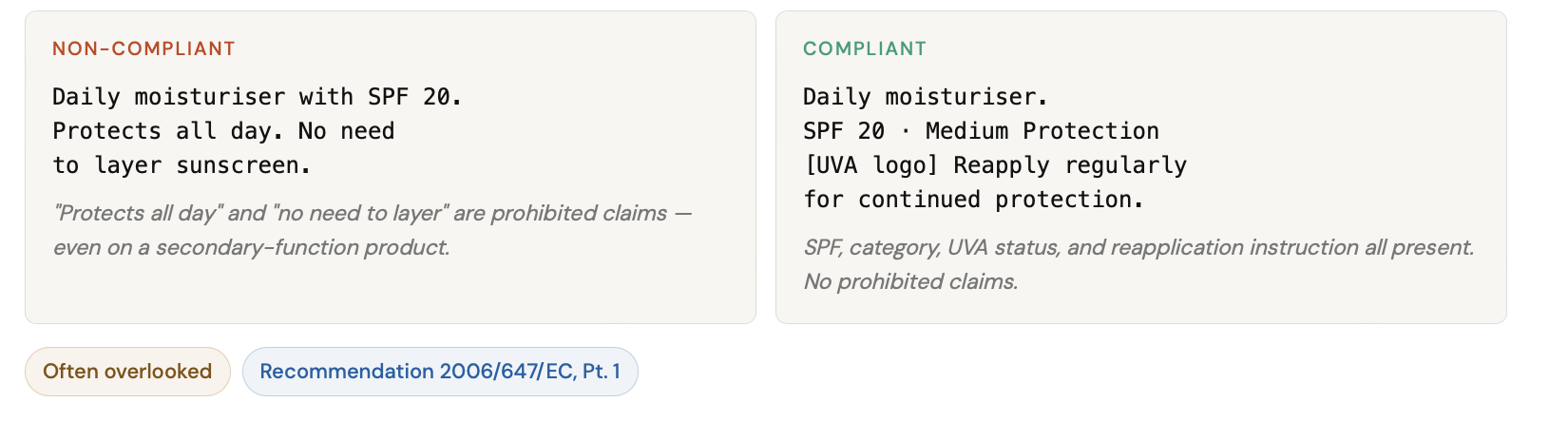 6. Recent regulatory changes affecting sunscreen formulations
Updated regulatory limits for UV filters
| UV FILTER | NEW MAXIMUM CONCENTRATION / STATUS |
|---|---|
| Benzophenone-3 (Oxybenzone) | 2.2% in body products and sprays (reduced from 6%) |
| Octocrylene | 9% in propellant sprays · 10% in all other products |
| Homosalate | 7.34% maximum · Only in face products · Not permitted in sprays |
| 4-Methylbenzylidene Camphor (4-MBC) | Prohibited in cosmetic products |
| Ethylhexyl Methoxycinnamate (Octinoxate) | Max 10% · Under regulatory review |
| Diethylamino Hydroxybenzoyl Hexyl Benzoate (DHHB) | Allowed with strict impurity limits (e.g. DnHexP control required). |
Products formulated above these limits cannot be newly placed on the EU market and must be assessed against applicable transitional provisions.
“Printing SPF 50 on a label is the easy part. Ensuring that the UVA ratio, category label, usage instructions, mandatory warnings, and claims all comply simultaneously is where most brands need expert support.”