
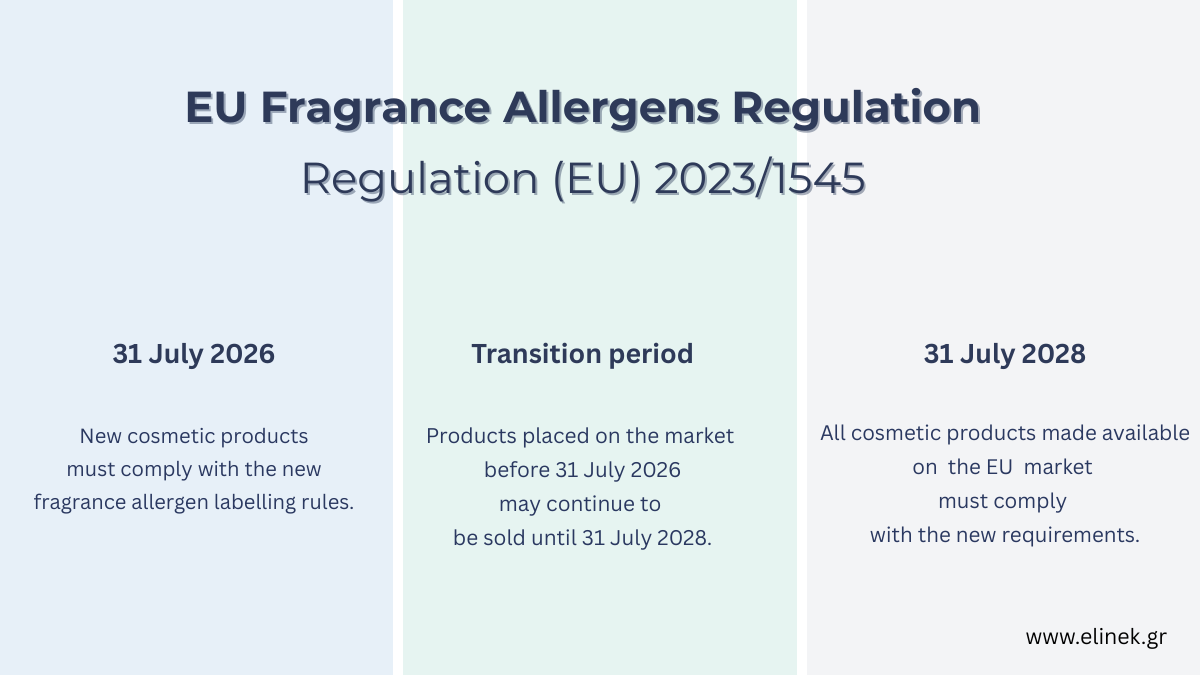
Regulation (EU) 2023/1545, concerning the labelling of allergenic fragrance substances in cosmetic products, amends Annex III of Regulation (EC) 1223/2009 on cosmetics.
The regulation significantly expands the list of allergenic substances that must be declared on the labelling of cosmetic products.
From July 2026, the new labelling requirements will apply to products placed on the EU market for the first time.
What is changing
Until now, mandatory labelling covered 26 fragrance substances.
Under the new regulation, the list of allergens is substantially extended and now includes more than 80 substances, which must be declared in the ingredient list when their concentration exceeds:
- 0.001% in leave-on products
- 0.01% in rinse-off products
Purpose of the new labelling requirement
The aim of this new requirement is to better inform consumers who have a sensitivity or allergy to specific fragrance substances, enabling them to identify and avoid ingredients that may trigger a reaction.
An allergen can be present in a cosmetic product due to:
a) Its presence in the fragrance or aroma mixture either added directly or as part of a natural complex substance (e.g., essential oil, botanical extract)
b) Its presence as constituent of a natural complex substance (NCS) (e.g., essential oil, botanical extract)
c) Its presence as an impurity or contaminant
d) A combination of two or more of the above (no contribution as cosmetic ingredient)
e) Its intentional addition as a cosmetic ingredient (i.e., not a fragrance or aroma mixture)
f) Combination of (e) and one or more of the above.
The new substances that must be declared on the labels when present are:
- Pinus Mugo
- Pinus Pumila
- Cedrus Atlantica Oil/Extract
- Turpentine
- Alpha-Terpinene
- Terpinolene
- Myroxylon Pereirae Oil/Extract
- Rose Ketones
- 3-Propylidenephthalide
- Lippia citriodora absolute
- Methyl Salicylate
- Acetyl Cedrene
- Amyl Salicylate
- Anethole
- Benzaldehyde
- Camphor
- Beta-Caryophyllene
- Carvone
- Dimethyl Phenethyl Acetate
- Hexadecanolactone
- Hexamethylindanopyran
- Linalyl Acetate
- Menthol
- Trimethylcyclopentenyl Methylisopentenol
- Salicylaldehyde
- Santalol
- Sclareol
- Terpineol
- Tetramethyl acetyloctahydronaphthalenes
- Trimethylbenzenepropanol
- Vanillin
- Cananga Odorata Oil/Extract
- Cinnamomum Cassia Leaf Oil
- Cinnamomum Zeylanicum Bark Oil
- Citrus Aurantium Flower Oil
- Citrus Aurantium Peel Oil
- Citrus Aurantium Bergamia Peel Oil
- Citrus Limon Peel Oil
- Lemongrass Oil
- Eucalyptus Globulus Oil
- Eugenia Caryophyllus Oil
- Jasmine Oil/Extract
- Juniperus Virginiana Oil
- Laurus Nobilis Leaf Oil
- Lavandula Oil/Extract
- Mentha Piperita Oil
- Mentha Viridis Leaf Oil
- Narcissus Extract
- Pelargonium Graveolens Flower Oil
- Pogostemon Cablin Oil
- Rose Flower Oil / Extract
- Santalum Album Oil
- Eugenyl Acetate
- Geranyl Acetate
- Isoeugenyl Acetate
- Pinene
The new requirements apply:
from 31 July 2026 for new products placed on the EU market
from 31 July 2028 for products already placed on the market
References: